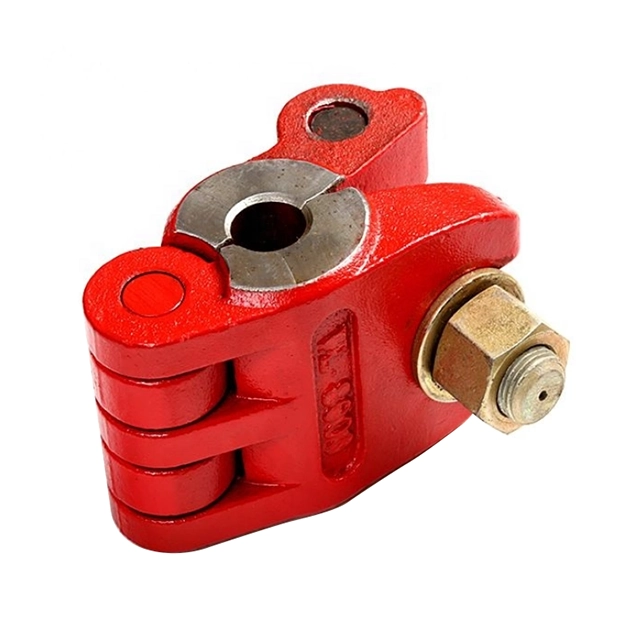
Artificial lift systems depend heavily on precise mechanical connections. You cannot afford weak links here. Polished Rod Clamps are the literal lynchpin of the artificial lift system. They carry the entire weight of the rod string and the fluid column. A sub-optimal clamp selection or improper installation leads to disastrous results. You risk string slippage, severe wellhead damage, and costly unexpected downtime. Choosing the wrong clamp compromises your entire pumping operation. Our guide aims to provide a rigorous, specification-driven framework for evaluating your options. You will learn how to select Oilfield Polished Rod Clamps based on load ratings and metallurgical standards. We also detail critical compatibility rules for specific rod materials to ensure peak reliability.
Key Takeaways
Safety Margins: Industry standards dictate that a clamp's maximum rated working load must not exceed 75% of its initial slippage load.
Surface Limitations: Clamps must strictly interface with piston-steel rods; clamping on hard-faced or spray-metal coated sections will crush the coating and induce failure.
Configuration Matching: The choice between single, double, and triple-bolt clamps must directly align with calculated dynamic well loads (ranging from 13,000 lbs to over 40,000 lbs) and material grades (e.g., AISI 1045 vs. AISI 1526M).
Installation Integrity: Over-torquing leads to thread galling, while improper lubrication (e.g., greasing the inner friction face) neutralizes holding power.
Understanding the Clamp's Position in the Lift System
Mechanical Load Transfer
You must first understand how kinetic energy flows through a pump jack. The motion begins at the horsehead. The horsehead moves up and down in a continuous rhythm. This energy travels directly through the wireline to the carrier bar. The carrier bar provides a flat, sturdy foundation. Your polished rod clamp sits firmly on top of this carrier bar. It grips the polished rod tightly. The clamp then transfers the reciprocating motion downward. The polished rod passes through the stuffing box and continues downhole. Ultimately, this energy reaches the downhole pump. If the clamp slips, the entire energy transfer process fails immediately. The rod string will drop. This drop often causes catastrophic damage to the wellhead equipment.
Vibration and Stress
Oilfield environments generate immense cyclical stress. The clamp isolates the stuffing box and pump seals from excessive mechanical wear. It achieves this by maintaining an unyielding grip. Rod-pump and PC-pump operations subject the rod to constant, heavy loads. The clamp absorbs significant vibration during each stroke. A high-quality clamp prevents lateral shifting. This stability protects the fragile internal seals of the stuffing box. When a clamp loosens, vibrations increase exponentially. These vibrations rapidly degrade the wellhead seals. You will eventually face fluid leaks and environmental hazards.
Baseline Compliance
Engineers must follow strict procurement protocols. Any procurement evaluation should begin by verifying baseline API 11B compliance. The American Petroleum Institute sets these rigorous standards. API 11B dictates exact dimensions and minimum load capabilities. Do not purchase uncertified clamps. An uncertified clamp introduces unacceptable operational risks. Verifying API 11B compliance ensures dimensional accuracy. It guarantees the clamp will fit standard rods correctly. It also ensures the manufacturer tested the clamp against recognized safety benchmarks.
Core Technologies: Friction-Style vs. Indention-Style Clamps
Manufacturers engineer clamps using two primary gripping technologies. You must select the right style for your specific well conditions. Both styles offer distinct mechanical advantages.
Friction-Style (B-Style) Clamps
B-Style clamps rely heavily on massive physical pressure. They use high-clamping force and surface friction to hold the rod. The internal bore of the clamp tightly squeezes the polished rod. These clamps do not alter the rod's surface geometry.
Mechanism: The clamp bore matches the rod diameter perfectly. Tightening the bolts compresses the two clamp halves together. This creates massive frictional resistance.
Ideal Use Case: Operators use friction-style clamps for standard operational loads. They excel when you need to preserve the absolute surface integrity of the rod. They prevent permanent surface scarring.
Indention-Style (F-Style) Clamps
F-Style clamps take a more aggressive approach to load retention. They feature specially designed internal profiles. These profiles slightly indent the rod surface upon tightening. This action establishes a secure mechanical lock alongside standard friction.
Mechanism: The internal ridges press into the softer steel of the rod. This indentation creates a physical barrier against downward slippage. It requires less overall bolt torque to achieve high holding power.
Engineering Advantage: This design generates exceptionally low stress-concentration within the rod itself. F-Style clamps also feature a highly compact footprint. Their small size makes them ideal for integration alongside rod rotators.
Feature | Friction-Style (B-Style) | Indention-Style (F-Style) |
Grip Mechanism | High clamping force and surface friction | Internal profile indentation and mechanical lock |
Surface Impact | Preserves absolute rod surface integrity | Creates slight, intentional surface indentations |
Footprint | Generally larger and heavier | Highly compact, lighter weight |
Best Application | Standard operational loads, pristine rod preservation | Use with rod rotators, space-constrained wellheads |
Selecting by Load Capacity and Bolt Configuration
Bolt configuration directly determines a clamp's maximum holding capability. You must match the clamp size to your specific well depth and fluid load.
Single-Bolt Clamps
Single-bolt designs represent the simplest clamping solution. They require minimal time to install and remove. However, their holding power remains limited.
Target application: Shallow wells and low-load scenarios. They work perfectly for stripper wells.
Typical metallurgy: Manufacturers use standard carbon steel. AISI 1045 or ASTM A536 ductile iron serve as common materials.
Advantage: You gain rapid installation speeds. They suit operations requiring frequent maintenance schedules and quick wellhead access.
Double-Bolt Clamps
Double-bolt clamps offer a critical upgrade in gripping security. They distribute the clamping force over a much wider surface area.
Target application: Mid-depth wells supporting moderate to heavy fluid columns. They represent the industry standard for most conventional operations.
Typical metallurgy: These require higher tensile materials. Engineers often specify AISI 1536M steel.
Advantage: The extra bolt significantly increases the surface grip area. This produces a massive reduction in slippage risk under dynamic, fluctuating loads.
Triple-Bolt Clamps
Deep wells demand extreme mechanical retention. Triple-bolt clamps provide the highest level of security available for mechanical suspension.
Target application: Deep wells, high-pressure environments, and extreme load conditions. These robust clamps handle ratings up to 40,000 lbs.
Typical metallurgy: You must use advanced high-strength alloys. AISI 1526M represents a top-tier choice for these applications.
Advantage: They offer maximum redundancy. If one bolt slightly loosens, the other two maintain the necessary holding power.
The 75% Slippage Rule
Engineers never operate equipment at its absolute breaking point. Industry standards demand strict safety margins. The 75% slippage rule dictates load ratings. A clamp's rated maximum working load must never exceed 75% of its initial tested slip threshold. For example, if a clamp slips at 40,000 lbs during factory testing, you can only rate it for 30,000 lbs of actual well load. This built-in safety redundancy of 25% protects your site. It accounts for unexpected dynamic forces, fluid pounding, and sudden pressure spikes.
Configuration | Typical Load Range | Primary Metallurgy | Ideal Well Environment |
Single-Bolt | Up to 13,000 lbs | AISI 1045 / ASTM A536 | Shallow depths, low pressure |
Double-Bolt | 13,000 - 25,000 lbs | AISI 1536M | Mid-depth, moderate fluids |
Triple-Bolt | 25,000 - 40,000+ lbs | AISI 1526M | Deep depths, high pressure |
Material Selection, Hardness, and Anti-Corrosion Treatments
Hardness Requirements
Material hardness dictates how well a clamp resists deformation. You must evaluate clamps that maintain strict mechanical properties. Industry experts typically require a hardness range between 190 and 300 HB (Brinell Hardness). This specific range ensures adequate strength without inducing brittleness. If a clamp is too soft, the bolts will crush the body. If the steel is too hard, it becomes brittle. Brittle clamps can shatter under sudden impact loads. Hitting the 190-300 HB sweet spot guarantees long-term durability.
Forged Steel vs. Ductile Iron
Material casting methods affect structural integrity. We highly recommend forged steel for most demanding applications. Forged steel provides maximum impact and tensile strength. The forging process aligns the grain structure of the metal. This alignment resists crack propagation. Alternatively, high-grade ductile iron (specifically 65-45-12) serves as a viable alternative. Ductile iron works well in specific, controlled environments. It handles moderate loads effectively but cannot match the sheer toughness of forged steel.
Surface Treatments for Longevity
Raw steel degrades rapidly in harsh oilfield environments. Manufacturers apply specialized surface treatments to extend equipment lifespan. You must specify the right coating based on local environmental corrosivity.
Zinc Phosphate Coating: This serves as the industry standard for aggressive wellhead environments. It offers superior corrosion resistance against salt water and hydrogen sulfide. Zinc phosphate also acts as an excellent primer for subsequent painting.
Blackened Anti-Corrosion: This process creates a dark oxide layer on the steel. It represents a more cost-effective treatment for less corrosive environments. However, zinc phosphating provides an added mechanical benefit. Phosphating actually improves the surface friction characteristics of the inner bore. This enhancement directly increases the clamp's gripping capability.
Implementation Red Lines and Avoidable Failure Points
A high-quality Oilfield Polished Rod Clamp is only as reliable as the rigor of its installation protocol. Field crews often make critical errors during setup. You must enforce strict installation disciplines.
The Spray-Metal Ban
You must observe the explicit warning against improper placement. Never install any clamp over a hard-faced or spray-metal coated section of the polished rod. Spray-metal coatings offer excellent wear resistance against stuffing box packing. However, these coatings are incredibly brittle under lateral compression. The intense squeezing force of a rod clamp will instantly crush the coating. This action causes catastrophic coating fracture. The shattered metal flakes will then destroy your stuffing box seals. Always position the clamp on the bare, piston-steel section of the rod.
Lubrication Discipline
Improper lubrication neutralizes the holding power of your clamp. Follow these strict guidelines during assembly.
Do: Apply light machine oil or anti-seize grease strictly to the bolt threads and washers. Lubricating the threads reduces friction during tightening. This allows you to achieve highly accurate torque readings.
Do Not: Never apply any lubricant to the polished rod itself. Never apply grease to the clamp's inner gripping face. Oil on the friction surface completely destroys the mechanical grip. The rod will slip immediately once you apply a load.
Torque and Alignment Tolerances
Torque wrenches are mandatory for proper installation. Avoid guessing the tightness of the bolts.
Control Torque Limits: Do not exceed the maximum recommended bolt torque. Torque limits typically range between 250 and 550 ft-lbs, depending on the specific model. Exceeding this limit causes severe thread galling. The bolts will fuse to the nuts, making removal impossible.
Ensure Flush Alignment: Require the use of a straight edge during setup. The clamp bottom must sit perfectly flush against the carrier bar. Uneven seating creates dangerous bending stresses in the polished rod. This misalignment eventually leads to rod fatigue and snapping.
Sequential Tightening
Multi-bolt clamps require a specific tightening sequence. You cannot simply tighten one bolt entirely before moving to the next. Detail the necessity of standard tightening patterns to your field crews. For a three-bolt clamp, you must follow a staggered approach. First, snug the middle bolt. Next, snug the top bolt. Finally, snug the bottom bolt. Once all bolts are lightly seated, repeat the sequence using a torque wrench. Apply the final torque in progressive stages. This sequential method ensures completely even load distribution across the entire clamp body.
Conclusion
Choosing the correct clamping mechanism secures your entire artificial lift investment. You must utilize a strict procurement decision matrix. First, base your initial selection on calculated maximum downhole dynamic loads. Do not estimate these figures. Second, precisely match the bolt configuration (single, double, or triple) to mandatory safety margins. The 75% slippage rule remains non-negotiable. Third, specify your surface coatings based on the local environmental corrosivity of your wellpad.
Even the strongest materials fail if handled improperly. A high-quality oilfield polished rod clamp is only as reliable as the rigor of its installation protocol. Field crews must respect torque limits, avoid spray-metal sections, and follow sequential tightening rules.
We recommend engineers take immediate action to secure their operations. Audit your current well loads against your existing clamp specifications. Look for equipment operating too close to its maximum rating. Identify potential safety gaps now before catastrophic slippage forces unexpected downtime.
FAQ
Q: Can polished rod clamps be reused after a well intervention?
A: Yes, provided they pass a strict visual and non-destructive inspection. You must thoroughly check the equipment for thread wear, interior bore scoring, and surface corrosion. If the clamp clears these checks and shows no signs of metal fatigue, it remains safe for continued field reuse.
Q: What happens if bolt torque specifications are ignored?
A: Under-torquing leads directly to rod slip, severe equipment damage, and unplanned downtime. Over-torquing causes immediate bolt thread galling. Galling damages the threads permanently, rendering the clamp impossible to safely remove, adjust, or reuse. You must always use a calibrated torque wrench.
Q: What sizes of polished rods do standard clamps accommodate?
A: Most industrial clamps are precisely machined to fit standard API rod diameters. These sizes typically range from 1" up to 1-1/2". You should verify your exact polished rod diameter before purchasing to ensure a perfect mechanical fit.
Q: What is the difference between a standard polished rod clamp and a hydraulic safety clamp?
A: Standard clamps are fixed mechanical devices used for continuous operational suspension during pumping. Hydraulic clamps operate quite differently. They are typically temporary, high-capacity safety devices. Field crews use hydraulic versions to secure the heavy string dynamically during complex workover and servicing operations.


